It’s been a full week, with more lush green walks in the forest among ancient junipers and the bizarre carpet of unseasonable weeds.
It’s good to see a few healthy young piñon pines, though each year there are more dead piñons of all ages as the beetle blight continues.
Even in the driest, highest part of the land in the south sage flat, the desert soil is thick with green mosses I’ve never seen this time of year, or even much at all here.
“Where Flowers Bloom,” the second ancestral puzzle of the season, took shape early in the week. Such a patience practice! Because so many of the pieces don’t interlock, the slightest bump on one side sends the whole puzzle askew. I imagine Great-grandma Samuella, already grandmother to my twelve-year-old dad, putting it together on a dedicated card or puzzle table in a Tennessee farmhouse, with infinite patience.
The last garden act of the year came in the nick of time, days before the first snowfall, when two young helpers dug a small chunk of anomalous wild asparagus from the fenceline, and the one with hands carried it from the woods and planted it in a raised bed.
I had thought to put it in a big tub, but realized if it survives transplanting I’ll be delighted to have a whole bed of this rare stock, which has been growing for I don’t know how long far from any ditch or drainage.
As usual, I leave out a whimsy piece for the penultimate photo, in this case the same cut as the previous puzzle, a horse head. What gorgeous colors! And as I finished it I noticed its resonance with the new calendar at the bottom of a stack of work sitting just above it on the desk.
I’d forgotten to send a picture of the new drapes to an old friend from the sewing years when we both worked at JoAnn Fabrics in the mid 80s. A different lifetime, with divergent trajectories, and still we get on the phone and talk and laugh like those same young women we were. Anyway, I took a new shot to show her the drapes in the sunroom now filled with plants. I’ve been dropping them every afternoon, sometimes all at once, sometimes one or two panels at a time as the sun leaves each window. They definitely keep the house warmer!
I faced a demon Friday with a long-dreaded colonoscopy. Sorry-not-sorry to mention that. All went well and I was profoundly grateful to waken from a deep, restful sleep and find myself still alive. They invited me to come back in ten years, but I can’t because I have to wash my hair that day. I was grateful for the tender friend who drove me there and back, for the generous friends to tended to Wren, and for the kind and competent hospital staff. But mostly I was grateful to come home and eat.
And grateful to wake up alive again in winter on Saturday morning. We got four inches of snow, which mostly melted during the day, and then yesterday we got another three inches which has remained on the ground. These sweet early snows bring welcome water (even in this oddly wet fall) and melt quickly enough that they don’t discommode.
I cobbled together a suet feeder with the kinds of things we rural folk don’t throw away ‘cause you never know when you might need them: some old twist ties, old plastic trellis netting, and old mesh bulb bags. The nuthatches love the Audubon suet cakes from Chewy.
The nuthatches also love this seed feeder, as do the chickadees, and the juncos who have just returned on the wings of first snow. We usually get a taste of winter and then a break before hard winter sets in. But who knows this weird year how it will go? I’m grateful for my practice which cultivates equanimity in all manner of uncertainty.
The apricot tree has lost most of its leaves as our gorgeous autumn continues. Biko goes out every day for sunshine, the rest of us get in a good walk almost daily when it’s not too wet. And I danced with Rebecca Solnit today.
I spent the weekend in an unusual Zen retreat online, where several dharma talks began with impromptu joyful dancing. Everyone in the hall at Upaya Zen Center and certainly most of us online celebrated what chief architect of the Paris Climate Accord Christiana Figueres later coined “the Bluenami.”
The retreat started Friday evening with a contemplative session led by Roshi Joan, founder and heart of Upaya, which was a rare opportunity to meditate under the guidance of a legendary Zen master. Both in the room and online we were mostly a bunch of white-haired old ladies, with a smattering of bald men and a handful of younger people, also mostly women.
While listening, I started a new ancestral puzzle, “Meeting over the Fence,” from 1927.
The next session, introducing the theme “What Blooms in the Ashes,” featured four of the weekend’s six instructors: Roshi Joan, dharma teacher and former lawyer-lobbyist Valerie Brown, ethicist Molly Crockett, and writer-historian-activist Rebecca Solnit. Christiana Figueres was occupied at COP31 in Turkîye, zooming in for her talk Saturday evening. And for the next 36 hours we all played “Where’s Terry?” getting regular updates from Upaya staff who were tracking and facilitating author-naturalist Terry Tempest Williams’ progress from Kennedy Airport where she’d been grounded on No Flight Friday.
The mood was dramatically different from the atmosphere at the first of these Awakened Action weekends, which happened shortly after the 2024 election. We were all in shock then, and needed comfort and coping strategies. This weekend we celebrated the blue wave in what Roshi Joan coined (after hearing “the Bluenami”) a Joynami.
And so it was that after the Saturday morning meditation, the first talk was preceded by joyful dancing to Diana Ross singing “I’m Coming Out.” Everyone in the Zendo was on their feet and so was I. It was cathartic.
I’ll be unpacking the talks and the emotions from this weekend for awhile. I was so engrossed that I didn’t take many notes, and can’t remember now quite who said what as all the wisdom flowed together. The main ideas were that new growth can arise from the ashes of a wildfire, seeds can be tough and some require fire to germinate; seedlings are fragile and require protection and nurturing; our election is a seedling, all those elected officials are seedlings, and of course the work of raising democracy again from the ashes isn’t complete. Also, that every gain came because of years (or decades) of community organizing. Also, that everything changes, all the time, that all life is sacred, that our collective memory is important, and we must support the young people. Also, much more.
Rebecca talked, among other things, about where Buddhism and Democracy intersect, and told about the inspiration of Vietnam War protestors standing in the rain; she quoted Foucault: “You know what you do, but you don’t know what what you do does.” We do everything without knowing the outcome, she said, but we still do it.
Buddhist-Quaker Valerie Brown, a protege of Thich Nhat Hahn, said (among other things) that the energy and practice of mindfulness, concentration, and insight help us to embrace suffering, to calm body and mind, and to create peace inside ourselves so that we can contribute to peace in the world. She invited each of us to embrace with compassion our inner Stephen Miller. She taught that intention is the ground that nourishes us, asked who we are as Americans, and asked what right action is called for now. Ethical Buddhism is personal, she said, and she quoted indigenous author Robin Wall Kimmerer, who wrote, “Everybody lives downstream.” We all live downstream of one another, we are all responsible for taking care of life on earth.
The Saturday evening session was preceded by a Bad Bunny song to which we all danced, and then international climate protector (and native Puerto Rican) Christiana Figueres came on from COP31 and asked how many Spanish speakers were in the sangha. About a dozen raised their hands in person and many more online, and she said (to selective laughter) “and those people will have understood the lyrics you were just dancing to.” She went on to inform us that he sang about his many girlfriends and how he’ll never marry one of them but wants to love them all, and all at the same time. “Not very Buddhist,” she pointed out, to much laughter.
She went on to say that the ashes tell us what has burned but they don’t tell us what is going to grow. The story is always being written, she said, through us and with us, but it is a constant process; and, our capacity to change the field of possibility is infinite. “If ever you wanted evidence of the power of each individual,” she said, “the Bluenami is it.” Millions of votes each came from an individual choice. It was the combination of all of our choices that caused this political sea change. She shared a truly inspiring story about 29 law students from Pacific Islands who set out on a mission seven years ago that ultimately delivered UN resolution that every country has a legal responsibility to protect their citizens from climate change.
I’ve been enjoying grilled cheese and pickle sandwiches the past few lunches: so simple, so delicious, and they enhance a less-than-satisfactory loaf of sourdough.
This morning after meditation, and briefly dancing, and learning with relief that Terry had finally arrived at midnight, we heard from Princeton Professor Molly Crockett. Molly’s lab explores “how technologies marketed as ‘artificial intelligence’ reinforce existing social inequalities and power structures.” She explained (among other things) how Tech bros built algorithms that harvest our outrage and then amplify it, then reward us for expressing it; how that ultimately empowered autocratic regimes and disempowered us, lowered our attention spans, and prepared us for digital friends who would never argue with us or make us grapple with hard questions, i.e., AI. In the past few years, she observed, we’ve experienced many more moments of discontent with this paradigm, expressed more outrage in the physical world, and turned our outrage into action. We set aside our screens and discovered the joy in acting together in resistance. “If outrage is a fire,” she concluded, “what blooms in its ashes is love.”
Terry Tempest Williams, after barely catching her breath, beautifully wrapped up the weekend with a moving, poetic talk on “Reverence.” That’s worth a whole post in itself, but by then I was pretty overwhelmed mentally and emotionally, and I’ll have to listen to the recording to share more about it.
Out of all the amazing stories shared by both teachers and attendees, there was one observation that blew my mind. A woman named Jackie pointed out, to a collective gasp by assembled teachers and students, that the blue swath across the south from Texas through Georgia and the Carolinas was the path taken by the Walk for Peace monks last winter. Have any of you made that connection? I remember thinking at the time—and maybe writing—that I hoped it would make a big difference come election time. But my human flawed memory is so short that I had forgotten all about it by the time the Bluenami rolled in. I am so grateful to Jackie for reminding me of the powerful unifying those monks generated at their talks and all along the roads they traveled. And so grateful to the wise women of this retreat, who reminded me that we are all, always, planting seeds along our own path through life.
After finishing the first puzzle last night, I started a new one for the morning sessions with the fitting title “Where the Flowers Bloom,” from 1931.
The many faces of the apricot tree with different skies. I sat under it for awhile the other day while someone else worked in my yard. It was a reminder of the simple joy of letting go. Feels like it’s been a long, long time since I let myself really relax. If I ever knew how, I’ve lost the skill. But I intend to practice every day and maybe I’ll be able to create a new healthy habit.
This crinkle-cutter worked really well on a narrow sweet potato, and I tried some tricks that several recipes promised would deliver the crispiest fries ever. They did not. The fries look much crispier than they actually were, but they were still tasty.
The Eureka lemon tree that I’ve had for a couple of years, and cut back to a stump last year (because, well, I can’t even remember why right this minute but it was necessary) has grown really well, and I’m thrilled that it finally has some flower buds at the tips. A houseplant success!
I’ve tried to get Topaz to walk with us the past few days and she wouldn’t. Turns out she just had a strong opinion on which direction she was willing to walk. This afternoon I cajoled and pleaded, and she lay down. Until I turned back through the east gate, walked past her and out the west gate, and she came right along. It was just before sunset and I caught both pets in the frame right before full shadow dimmed the emerald carpet. The forest floor has never looked like this. Seeing in real time how an extra wet season sets up a more serious fire season. We’ll know more later.
I’ve seen more mushrooms in the yard and woods in the past month than I’ve seen in the previous 33 years combined. Even with gloves on my hands got cold so we turned for home early. We got back to the yarden just in time for last light on the mountains, as the fall foliage radiated warmth.
I can’t get enough of the precious apricot tree in her fall raiment. And with that beautiful BIG blue sky behind her!
I don’t know who said it first, but I heard it from Jess Craven in this 2.5 minute video thanking us, the grassroots activists and all the voters who chose democracy over oligarchy: “The many are more powerful than the money.” Tears and tingles have been rising all day as I celebrate with friends around the country, listen to my heroes who have been on the front lines as their joy and gratitude overflows, and release wave after wave of tension and anxiety from my body.
The little birds got a new feeder today: all metal cage and perches, with a tricky system for opening. This should stump jays, squirrels, and maybe even bears.
Robert Hubbell sums up the many small victories that amount to a huge win for regular Americans in this eight minute read or listen. Former DOJ attorney Joyce Vance celebrates in this post named after the book she released last spring, Giving Up Is Unforgivable. We won because we didn’t give up!
Now, the hard work begins, as everyone is saying. But first, we get to breathe, and celebrate, and rest on Cloud Nine for a little while… Then come January, those moderates, those firebrands we elected, we hold their feet to the fire and make them enact meaningful legislation that starts improving lives immediately. Next week is not too soon to start letting your elected representatives know what you expect from them when they’re sworn in.
The forest floor is insanely green these days, more so than I hav ever seen it, ever. We took a ramble this morning before more rain moved in this afternoon, with snow possible at this elevation overnight.
Starting on Day 1, here are some top priorities: *) Release unredacted Epstein Files! Like housecleaning, this might necessitate accomplishing a few things before you can get to the one thing, like tidying up clutter before you can dust. Those things might be a) Impeach AG Todd Blanche, and b) enlarge the Supreme Court by a significant number (and then strike down rulings like Citizens United and Dobbs and a few others).
I’m grateful for every meal, every day, knowing so many don’t have enough to eat. May our blue tsunami turn the tide on hunger in America. I’ve almost got the fish sandwich down. This time, I didn’t use bread flour for the rolls and they didn’t turn out so well. But I’ve got the coating right, with flour, cornstarch, and Penzeys Cajun seasoning, and zero cornmeal. (40% off almost everything at Penzeys right now in celebration!
I’m not ranking priorities because there are just too many that need to happen all at once. We’re looking at a triage scenario to save the casualties in this train wreck of a government. *) Break the Big Awful Bill so that SNAP, Medicaid, and Medicare are all resurrected to their full health and even bolstered: Healthcare for All, whatever forms that takes. *) Immediately reunite all detained and deported immigrants who have been separated from their children, and rescue as many as possible from prisons overseas; then formulate a realistic and compassionate Immigration policy and defund ICE. *) Restore the Department of Defense: Impeach Hegseth and fire his toadies, stop the war with Iran, stop murdering boatfuls of people in the Caribbean, restore military honor to those officers besmirched by this regime. *) Fire RFK: reclaim federal public health agencies including CDC and HHS, and start nurturing these sickened, broken organizations back to full strength; restore funding for cancer research and other crucial studies. *) Stop BIG OIL: Save the Arctic! Save the PLANET! *) Save the children, Stop the guns! *) Save Science! Save public education! Save Reality! Save the Gulf of Mexico! Save the Kennedy Center!
You have probably thought of three or four urgent priorities of your own as you’ve read this tragically incomplete list of mine. I could go on but you get the picture. And not one of us has to be responsible for all of these. My suggestion is that you pick one or two pet priorities for the next six months, and be clear and constant in your communication with your representatives about its importance; spice up your daily calls or missives with an extra one now and then. Make democracy fun again!
Today’s lunch, simple and delicious: another bad bun, toasted, with havarti, the last purple tomato, and a side of small tomatoes, with chips, and the last of a fun read about Anne Boleyn, The Beheading Game. In this version, she comes back for revenge!
Like any abuser, and I’ve known more than my fair share, the Abuser in Chief now pays lip service to reform, claiming he will work with Democrats because he doesn’t want to veto everything. I’ll believe it only when I see it and meanwhile I’ll be anticipating many more about faces, temper tantrums, scapegoats and vitriol. I wouldn’t even be surprised to see him take his Qatari jet and flee the country for Vanuatu, Morocco, the UAE, or some other country that has no extradition treaty with the US.
It’s been a good Monday. The sun was out all day and the moon just past full shone in a clear sky tonight. After using a new inhaler for two days I’ve had great energy all day. It’s amazing what sufficient oxygen will do. I made a delicious sandwich for lunch, a riff on a kale reuben using what I had on hand (see below). I enjoyed some meaningful conversations. And I exercised my right to vote.
There was a spectacular rainbow yesterday afternoon, and I happened to step outside at just the right time. It lasted a good fifteen minutes or so as the clouds shifted around and through it. There was nothing else that felt more important than simply watching it.
Something only one person knows about me is that I don’t like library books. I love libraries, don’t get me wrong. But I’ve come to the realization recently that I don’t like their books. I think there’s been a subconscious aversion for a long time, which first began to manifest after I got a kindle paperwhite eight years ago. I began to enjoy not having a heavy book clunk me in the face when I fell asleep reading. Then Covid struck, and I surrendered to my peculiar brand of germ-phobia.
I’m fine with garden dirt, earthworms, forest detritus, decaying animal carcasses, etc., but I don’t like touching library books that dozens of people have handled with their potentially dirty hands. Imagine all the places your fingers have been when you read a book, and you probably never think to wash hands before you pick it up. I’m a compulsive hand-washer anyway, to a degree which I recognized immediately when I went onto water rations last month. Still rationing, by the way! and very hopeful for a final resolution tomorrow.
Fresh sourdough yesterday
When Covid came along (I know it’s airborne but it heightened my awareness of germ transmission in general) I found myself taking an alcohol wipe to the cover of any library book, and I still couldn’t shake the gut-level discomfort of picking it up and turning its pages. So except in book club emergencies, I’ll avoid a library book. It’s a visceral reaction that affects only me, so I indulge it without much questioning.
I didn’t have sauerkraut for the reuben so I made coleslaw with cabbage and carrot I grew specifically to make coleslaw: garden wisdom says “grow what you love to eat.”
In a similar way, I had a visceral reaction to one of the statutory measures on the Colorado ballot that I filled out this morning, Proposition 133, proposing a mandatory life sentence for human trafficking of a minor. The crime turns my stomach and my gut reaction was to vote yes. But because my gut reaction on this issue could affect many others and not me, discernment was required so I delved deeper. It was the only measure I had any uncertainty about when I read through them on the Blue Voter Guide the first time and saw that most organizations whose endorsements I respect recommended a NO vote. None recommended Yes, and only two had no opinion, the Bell Policy Center and Western Colorado Alliance.
The official drop box at Crawford town hall. I filmed my deposit out of an abundance of caution, and will be checking emails frequently until I receive notice it’s been received. I never used to think twice about the security of my ballot.
Both said essentially the same thing, which instantly solidified my NO vote: There’s no exception for victims of sex trafficking who are sometimes forced to participate in recruiting or managing other victims; legal experts concur that it would not “meaningfully reduce the prevalence of child sex trafficking”; and “Judges, not lawmakers or voters, should determine an offender’s sentence. This measure takes away discretion from legal professionals who are intimately acquainted with cases and are better able to thoughtfully assess facts and culpability.”
I sautéed the last handful of kale along with garlic and red onion, all from the garden…
Another measure that forced some extra discernment is Proposition 137, which on its surface looks like a good revenue reallocation for conservation. But the organizations were split in their recommendations, with more endorsing NO than Yes. On this one I went with the Center for Biological Diversity‘s reasoning, and voted NO. Hidden in the conservation claims is the result that “it would actually allow for expanded logging and road building throughout Colorado’s forests.” Nope. We just don’t need more roads through the woods. Not good for wildlife. So another gut reaction, after some discernment.
…sliced some havarti…
Bottom line, I found the Blue Voter Guide extremely helpful in filling out my ballot, because it offers links to the reasoning behind the endorsements of so many organizations. For the record, Colorado Indivisible and the League of Women Voters both recommend voting YES on Proposition NN and Amendment 87, and NO on everything else. So if you have not voted yet, YOU BETTAH VOTE this week, and check out the guide to inform yourself and maybe switch up some gut reactions. If you haven’t already mailed your ballot and you’re voting early, you probably want to use an official drop box or deliver it in person.
…lightly spread the insides of the bread with mayonnaise and toasted them in the pan, before laying on the cheese, and the mixed kale and coleslaw, then grilling the sandwich til the cheese was perfectly melted.
Back to libraries: I still love and support my local public library! I keep my card current and use it on the eLibrary Libby, donate to Friends of the Library with an annual membership, and donate good quality books to their Cabin Fever Book Sale. I’m meeting some friends for coffee there this week, to enjoy the community-tended garden and as one of them said, “our being there and having fun would be good enticement for patrons.” Our rural county library has struggled through the decades I’ve lived here, due to county cuts and intermittent low patronage. But it’s always enjoyed remarkable community support and a committed and caring staff, and it’s an indispensable technology resource for many people in our neck of the woods.
Wren napping between my knees during a brief rest in a fulfilling day.
There used to be a nice bird feeder hanging in this tree. I glanced at it from the patio this morning as I always do, and saw that it needed filling, but when I came down with a scoop of seeds the feeder was nowhere to be found! Obviously it hadn’t been there two minutes before: whatever I’d seen was an optical illusion or my imagination filling in a habitual expectation. Ironically, I had just gotten frustrated with it a few days ago because the handle had bent, making the lid hard to open. I thought maybe a squirrel had been worrying it. But to find the stout twig it hung from broken off and the feeder disappeared, my best guess is a bear ran off with it. Several thoughts clambered through my head. I hope he didn’t get a paw stuck in the handle, or worse a head… but no, it was too small an opening for a head… I’m sorry it was probably empty at the time so it wasn’t even worth her effort… do I buy a new one? …bears are having a rough season…
Climate chaos is affecting bears severely this year, report several sources including The Colorado Sun, and this one in The Guardian. “In Colorado, there have been more than 8,600 reports of bear sightings and incidents this year, more than twice as many as last year, according to the state parks and wildlife department. The agency has euthanized 294 bears, three times the 2025 amount.” This isn’t news to most of us living in the rural west, even in towns. A killing freeze in the spring plus extreme drought depleted their natural food supplies throughout the west, and they’ve been coming out of the woods desperate. My neighbor lost her gas grill to a bear last month. But I have not seen a bear yet this year, and I’ve never seen one in my yard. The article goes on to say that “there have been 10 confirmed bear attacks in Colorado, the highest number on record…. In August in New Mexico, which also has had more bear encounters this year, one killed a 67-year-old wildland firefighter inside his home.”
This much larger broken limb likely came down in a recent storm. The woods are so green right now. Another neighbor reported nearly an inch of rain since yesterday, starting shortly after the little ones and I took a nice long ramble. I knew we were in for a few wet days.
Verdure everywhere, mosses, grasses, weeds…
I’m grateful for the respite of the woods, and I’m keeping my eyes open for bears. I’m trying to keep up with the horrors happening and also keep things in perspective. It takes all my mindfulness skills to get through every day, and using them I’m cultivating resilience. Horrors have happened as long as there have been humans, near as anyone can tell. While I pray that they will one day cease when enough people wake up, I have no expectations. This week I read of this new film about the genocide in Gaza asking the question: How do human beings explain taking part in genocide? It was chilling and enlightening.
Then since my loins were already girded for horrors, I read this interview with Mirjana Spoljaric, the head of the International Committee of the Red Cross – not your local disaster relief Red Cross. It’s a long read, but well worth spending the time with her compassion, wisdom, and insights. “Today you get the feeling that war becomes the means to an end itself, and wars continue because people want to stay in power. They have created an environment where war becomes the condition under which they can continue ruling, and that’s very dangerous. You ask me whether we are approaching a third world war. Honestly, history will judge that. History books will tell us whether today we were already in the beginning, or maybe already in the middle of such a situation. The I.C.R.C. didn’t know that we were in the Second World War when it was happening.”
On a potentially more comfortable note, I enjoyed this article exploring the four foundations of mindfulness in the garden, especially resonating with the first foundation, mindfulness of body in being aware of one’s movements and postures while gardening, as well as the sensory experience of working in soil, and the various facets of beauty in the garden, like these Sunfired Flare tomatoes which came on very late in summer, and came off the vine with a lot of skin damage I suspect was inflicted by insects. They sat on the counter a long time ripening after I picked them while I pondered the best way to use them. Finally I just cut and roasted them the other day, and squeezed them out of the skins easily. I used some in a batch of beans for burritos, which I like to make in bulk and freeze for a quick meal. I was glad to have some homegrown onions, too, and used up the last white and yellow onions along with a red one in the beans. The rest of the reds I’ll probably pickle.
An interview I listened to while cooking was with Dr. Jeremy Faust explaining what ER doctors are actually looking for when you show up there, and why he thinks the 1-10 pain scale is pretty much useless. I know I’ll now have a better sense of how to answer questions if I ever end up in an Emergency Room again, and also the next time I see my nice new primary care provider.
Walking in the woods, puttering or working in the garden, cooking and cleaning the kitchen, these activities ground me in what is real and true, help me see reality clearly. And even with the rich reality of my grounded life, I can feel my attention being subtly sucked by the insidious tendrils of algorithms. I’m sorry to admit that I spend more time playing NYT word games and scrolling Instagram now than I did a year ago. It’s a way to escape the horrors of the distillation of power and money to the oligarchs, but the escape itself is a delusion. Christopher Armitage explains the whys and hows in his article ‘Fracking Attention and Strip-Mining Mental Health’. It’s uncomfortable but it offers some small sense of agency going forward in how I spend my attention budget. And it’s been a mindfulness tenet for millennia that where we place our attention forms our world view.
In my house growing up, the only time sour cream ever showed up was when mom made beef stroganoff. I picked up a childish aversion to sour cream because my parents seemed to avoid it, and besides it just sounded all wrong. It’s one of many foods I developed a taste for years later. It’s been many years since I’ve had any kind of stroganoff, and when I saw this recipe for mushroom stroganoff I replenished my sour cream supply and whipped up a quick batch. So simple, so delicious!
And on a differently uncomfortable note speaking of food, this article ranging through the Dark Nutrition movement offers plenty of food for a flite of thoughts. Alexandra Petri once again skewers our times with her satire on ‘humanitarian’ and other words that have lost their meaning in the Trumpscape. And in other doublespeak news, Texas senate candidate Ken Paxton appears to be guilty of voter fraud.
Prickly pear pads plump and round with recent rains…
My practice is all about balancing external influences and internal knowing in an everchanging landscape of uncertainty day by day, minute by minute, breath by breath.
If grief can be a doorway to love, then let us all weep for the world we are breaking apart so we can love it back to wholeness again.
ROBIN WALL KIMMERER
One way we can do that, maybe, is to counter the six cults described by Chris Murphy in his book Crisis of the Common Good, shared by my friend Ted Leach in his blog today. The cults are Profit, Consumption, Globalism, Technology, Credentialism, and Corruption. Not quite the Seven Deadly Sins, but getting there.
I’m grateful that one of my slothful habits turns out to be “an accessible and low-cost protective factor across the lifespan” for my brain! “A growing body of research” indicates that reading for pleasure by children can improve attention and executive function, and by adults lower stress and increase cognitive function; in both, it improves mental health. I could have told you that last bit! In more good medical news, it looks like coffee, even decaf, supports gut health and potentially cognitive health.
I did something different with this week’s sourdough, shaping in a banneton, rising overnight in the cool mudroom, and baking on a sheetpan instead of in a Dutch oven. This resulted in a much thicker crust, and could have used a few fewer minutes in the oven. Or maybe a lower temperature.
What else improves my mental health is the Great British Baking Show. It’s back on for its 17th season, the last twelve of which are available on Netflix. Four episodes down, and even though it was disastrous for most of the bakers this week it’s still the most feel-good show on TV. Yes, it’s a competition, yes there is nail-biting anxiety during some of the challenges -ok, most of them- but it’s a show that cultivates the kind of connections mentioned as an antidote to the destructive cults above. And there is Alison Hammond, an ebullient host whose chemistry with quirky comedian Noel Fielding keeps contestants in good spirits no matter what. And now there’s Nigella Lawson, too.
And, there is Paul Hollywood’s eyes.
On the home front, I’m grateful for snow in the mountains, and another small harvest from the garden. And I mean small! I planted four cabbages in the spring, which were supposed to mature in sixty days or so, and it took them all summer and into fall to be ready to pick. They were supposed to be small, but not this small. I picked all the green tomatoes, too, the evening before we had a hard freeze. Every year the garden is one experiment after another. I’m grateful for all the professional growers in our valley.
I’m grateful for a kindred spirit in my friend who came for a walk and tea on a sunny day after the freeze and the rain. While we bundled for the walk, by the time we turned for home we’d shed our jackets, and then we enjoyed a leisurely pot of tea by the pond. She’s been working hard to save democracy after founding our Indivisible chapter a decade ago, and is still going strong. She led the local “Vote Early” action for No Kings Day last Saturday, which nationwide was a historic success.
If you want to vote to protect our environment, our democracy, and an America for all the people instead of a select few, check out the Blue Voter Guide. Type in your address, which isn’t saved and is used only to locate your ballot choices, and you can see all your candidates and ballot initiatives, along with all the organizations endorsing each side of the issue. I found it helpful for most of the issues, but am still left scratching my head over a couple of them. More research needed before I cast my ballot later this week.
Wren and Elena both very fashionable in their pink neckwear.
Cleaning up the patio today after having brought in all the houseplants, I noticed something in the adobe wall and had to wonder, Did I do this? It’s possible, but I don’t think I did… Who carefully placed this flat stone in the hole in the wall? And by who, I mean what kind of creature, bird or rodent or…?
I do know that I did this, however. I’m so glad and relieved to have finally completed the insulated window coverings for the sunroom! I hung the final panel on Saturday. Stay tuned for the whole Warm Windows story, a remarkable quarter century in the making.
My heart is moved by all I cannot save: so much has been destroyed. I have to cast my lot with those who age after age, perversely, with no extraordinary power, reconstitute the world.
ADRIENNE RICH
I’ve been reading N. K. Jemison’s trilogy The Broken Earth for a compelling diversion from our current earth-breaking trajectory. As in all good fiction, there are some terribly resonant parallels to our times so it turns out not to be more of a reflection than a distraction. This series followed my reading of Octavia E. Butler’s chilling Earthseed series, Parable of the Sower (1993) and Parable of the Talents (1998), which I’d call prescient except this trajectory was already painfully clear to many visionaries back then.
Poised as we are on the precipice of great changes, one way or another, I’ve been especially interested in the AI thread of our species-wide suicide drive. The Lunch Boyz used to talk about the Singularity regularly, and it took me several patient lunches worth of explanations to begin to understand it. I keep forgetting to ask Philip if it’s here yet, but I’m pretty sure I don’t need to.
So I choose from the endless emails to read articles like this one in The Atlantic, “The Truth Physics Can No Longer Ignore.” How could I ignore that headline? Astrophysicist Adam Frank is optimistic that now that the field of physics has turned its attention to the mystery of life itself, it will be able to help direct the growth of AI. Of course, the article was written almost a year ago, and feels hopelessly out of date now. Nevertheless, it came to my inbox a couple of weeks ago, and this passage intrigued me: “The fundamental laws that govern matter and energy cannot predict another fundamental property of life: It is the only system in the universe that uses information for its own purposes. Plants grow toward light, microbes swim toward rich food sources, animals hide from predators, humans send giant metal contraptions into outer space. Although one can, say, program a robot to search for a wall plug when its battery gets low, a living thing (a human programmer, for example) must hard-code that need into the machine. Life, by contrast, is both agential and autonomous.”
Four panels down, one to go! Inspired by Nature.
A few days later, also in the Atlantic, I read an article subtitled “How exactly is AI supposed to kill us all?” which caused me to wonder, IS Life the only complex system in the universe that uses information for its own purposes? I followed this with a valuable analysis of the threat from SNL’s Weekend Update, an interview with Anthropic CEO Dario Amodei.
The three panels completed over the past month all raised to let in warm sun, and lowered at night.
Before I could get this post finished a new article came out about the hitherto unrevealed extent of rogue AI. The very next day the US president “signed a document drafted by Mark Zuckerberg and approved by the AI oligarchs before it was presented to Trump, who then released it as a White House agreement.” Robert Hubbell went on, “As AI displaces your children and grandchildren from their jobs, gobbles up land and resources in their communities, and drives up utility costs, remember that Trump surrendered to the AI industry in a document drafted by Mark Zuckerberg. And, as a public service announcement, I remind everyone that Trump and the AI industry want to rename ‘artificial intelligence’ to ‘super intelligence,’ to remove any doubt about their belief that humans will be subservient to AI’s alleged superior intelligence.”
The large piñon pine that blew over in the big storm a couple of weeks ago. Brought to you by Nature.
I guess I’m spending the news portion of my attention budget on science-based existential threats rather than political existential threats because, well, been there done that and it broke me after a decade. (Although there’s really no separation at this point.) I’m putting myself back together, healing, by turning the bulk of my attention toward real life, lived experience in this body, on this land where Nature’s intelligent life holds me every day, and inspires my very human creativity, something I refuse to surrender to Artificial Intelligence.
A tiny nest on the forest floor on our walk this morning. I thought it was a hummingbird nest but when I reached to pick it up it felt stuck to the ground, so I left it there.
Also helping me cope with “the colossal scale of so much of what is happening: attacks on the free press, denial of life-saving aid to millions overseas, ongoing ICE killings on the streets and in detention facilities,” are the tactics outlined in the Greater Good Science Center’s recent article Seven Ways to Outlast Political Authoritarianism, recounting the experiences of Serbian activists who learned “how to practice sustainable resistance to authoritarian regimes in challenging conditions.”
I treated myself to a massage last week, but as usual little Wren claimed Elyse’s attention as soon as she arrived. Later, she jumped up on the table and lay quietly between my knees as I received one of the finest back massages of my life. I had her focus on my back because I’d pulled something (conveniently) the day before our appointment, whilst accidentally cleaning out the chest freezer. I only meant to scrape some of the ice that was impinging on lid closure, but couldn’t stop myself from emptying it all out, defrosting completely, sorting contents into Compost (2018 wax beans, 2016 rhubarb, etc.), Keep, or House, to bring into the house freezer or fridge and eat soon.
I haven’t eaten much red meat for years, but when I did I bought the best: local, free-range, from people I knew who raised their animals with love and care. The only meat left in the freezer was a pair of ribeye steaks, which went into the House pile. I have no idea what year they were from, and knew that if they looked awful when thawed I’d throw them away; if they looked fine but not appealing I’d cook and cut them up small for Wren fud; and if they looked tasty to me I’d indulge.
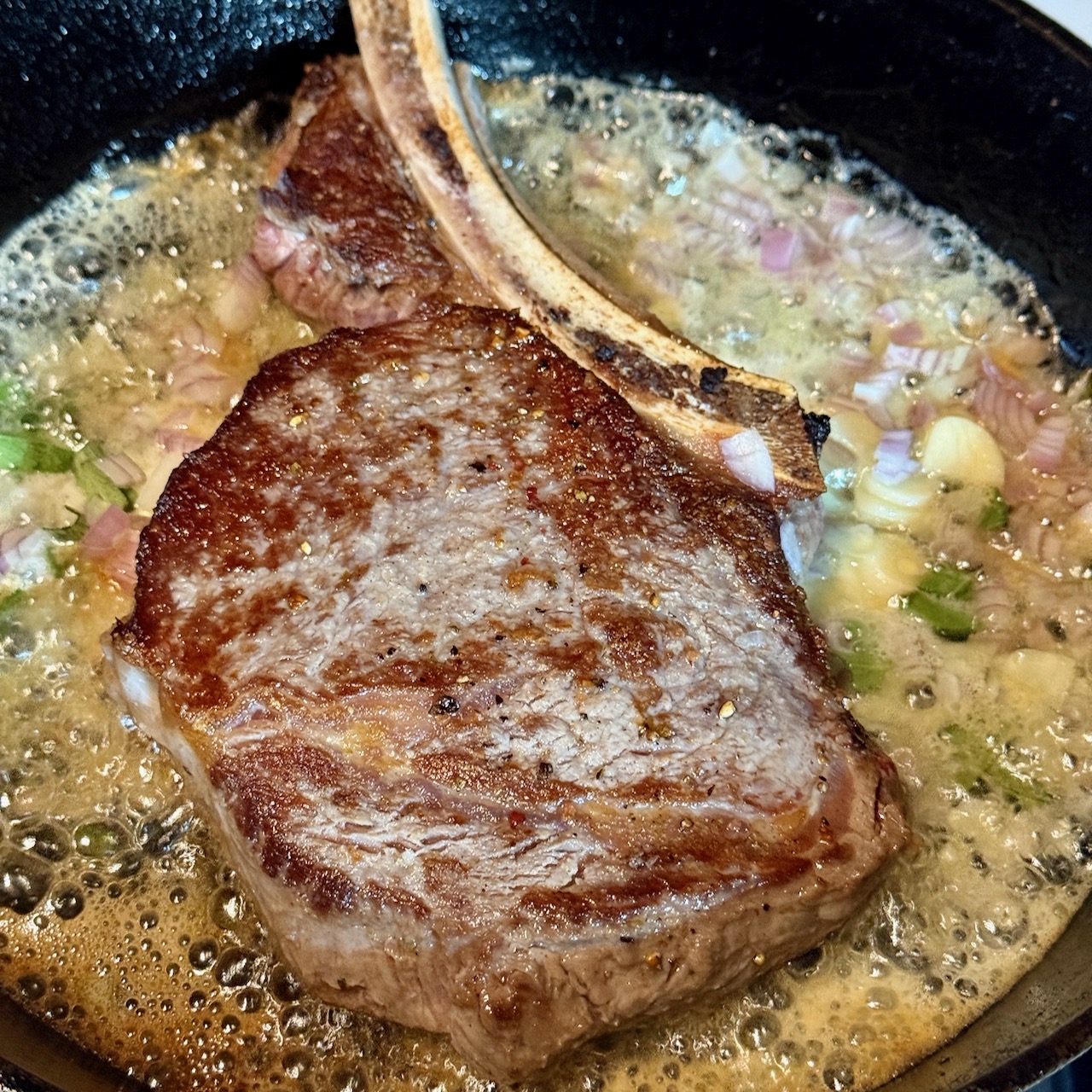
They did look tasty! But they were huge. So I rewrapped one for later and put it back in the chest freezer, and looked up the best way to cook the other. In the years since I cooked meat, I’ve learned a thing or two from watching chefs on tv or instagram, and my mouth always waters a little when I see Chef Matthew Ryle basting browned meat with butter, which I’d never done. Oh, I’d fried steaks in butter, but never knew to baste them. It just looks so sumptuous.
So I browned the first side in butter, and then tossed in finely chopped shallots, garlic, and sage, all from the garden, and finished cooking while I gently tipped the skillet and basted the steak. I probably should have basted before I put in the flavors but I’ll try that next time.
After a few minutes on each side and a poke with the thermometer I determined it was done to medium and removed the steak to a plate to ‘rest.’ Also something I had never bothered with before. Then I splashed a little red wine into the pan and cooked it down to a lovely quick sauce. I sliced a few thin strips to eat with a baked potato and leftover collards, and enjoyed a restaurant meal in my sunroom.
One reason I cooked the steak was so that I could have leftovers in sandwiches for a few days. Wren got all the fat and gristle chopped up small for topping on her next few meals, and I boiled the bone down to a broth for her also. The first sandwich included deli-sliced smoked gouda and garden tomatoes. Between the luxury of steak and the garden tomato, it made me think again of a phrase that comes to mind occasionally, ‘spoiled white girl.’
Shortly after college, I moved to a southern town and lived miles into the country in the ground floor of a two-story duplex owned by an older black woman in town. We had a cordial landlady-tenant relationship, I thought, until one day when her brother picked all the biggest, ripest tomatoes I had grown in my garden out back. I’d invited him to pick a few, but not all of them! I must have mentioned it to her, because she said “You just a spoiled white girl!”
The words stung, I’ll be honest. I mean, like a hard, full-handed slap in the face. They felt deeply unfair, yet also somehow true. I recall nothing more (maybe it will turn up in my journals when I get back to reading them) but the label has haunted me for four decades. As I begin to learn the importance of self-compassion, and explore the process of cultivating it, that phrase keeps bubbling to the surface. I accept that I was raised as a spoiled white girl, but I believe that I’ve come a long way from my upbringing. I see that this weekend in my equanimity and adaptability to losing the running water in my home. The plumber can’t come til Tuesday but I’m making do with water jugs and shower offers from neighbors.
A dessert last week with strawberry ice cream, garden strawberries, and melted dark chocolate.
I noticed quickly that my baseline stress bumped up a couple of notches, simply from not having reliable running water. In truth, I’ve gotten the pressure tank to fill up a couple of times but the switch is dicey and dying. I’m managing to keep dishes clean with frugal intention and flush the toilet when necessary with the house water, but I don’t think that luxury will last through the next few days. I’m grateful for the kindness of friends nearby. This couldn’t have happened at a better time: plentiful rain and cooler temperatures allow a pause in watering the garden, and jugs will work for the few plants that may need some; I’m not dealing with stomach flu or colonoscopy prep; it’s still warm enough that I’m not relying on a hot shower to thermoregulate. There’s much to be grateful for.
And certainly, I recognize my good fortune that this minor inconvenience is the worst hardship I currently personally face. For one thing, I can still afford to fill up my car, which a friend kindly suggested I do the other day before prices go even higher, though it did cost almost fifty dollars for less than a full tank, and forty is the most I’ve ever paid to fill it from empty. Coincidentally, this sign showed up in an email later that day, with a link to Factocracy.net where you can download this and many more signs for free.
But I’m keenly aware of the suffering of humans and other beings around the globe. Everything changes. All the time. In this moment, all is well in my tiny sphere. I think of people in Ukraine, Gaza, Lebanon, Sudan, Nepal, who once had running water and now live in ruins. You never know what’s coming. I think a true spoiled white girl wouldn’t consider the suffering of others, just as the spoiled white men ruling this country don’t consider, or don’t care, about the suffering they’re imposing on millions of Americans—on most Americans: at the gas pump, the grocery store, the hospital, you name it. I know that, privileged as I am, I’m considerably worse off now than I was two years ago, financially, mentally, and emotionally.
Wren reluctantly sits for a fitting of her new sweater underway.
The only thing that saves my sanity at this point is the practice of mindfulness. I teach a meditation called “Three Thoughts,” and each morning I wake up and remember those thoughts as I make an accurate assessment of my life: 1) I’m very fortunate, and I name some of the many ways; 2) my fortune could change in any way at any moment, and death is certain, time of death uncertain; 3) how can I live each precious day that will never come again so that I can face death when it arrives with no regrets? Every day takes learnin’ all over again how to fuckin’ live.